Front Row › Formula E 2026/27 › How it works
How Formula E 2026/27 works
How Formula E 2026/27 works: pick four drivers and two teams under 100.0 credits, carry the squad all season, name an Attack Mode driver each weekend, and trade in a market that reprices every window.
If you follow F1, you know half of this already. Formula E races on city streets in electric cars that can’t go flat out from lights to flag, and nearly every rule in Full Charge borrows from something that happens on track. Each section below is a pair: what the racing does, then what the game does with it. About ten minutes, start to finish.
The weekend
On track
A Formula E weekend is short and busy: practice, then a qualifying session for each race, then the race. A double-header runs the whole thing twice, on consecutive days.
In Full Charge
Your squad, Attack Mode and chips lock once a weekend, at the start of the first qualifying session, and that one lock covers both races of a double-header. Thirteen locks, not 21. Mexico City locks Sat 16 Jan, 14:00 UK · 09:00 US Eastern (provisional until the official timetable is out).
One lock means nothing is decided after a race you might have missed. Sleep through Saturday’s race and you’re no worse off than someone who watched it live: every squad was set before qualifying started.
Qualifying Duels
On track
Qualifying runs in two groups. The fastest four from each go into the Duels: quarter-finals, semi-finals and a final, one lap each, head to head. From this season the Duels pay championship points: one for getting there, one for each Duel won and one more for pole.
In Full Charge
Duel points follow the official ladder: 1 for losing a quarter-final, 2 for a semi-final, 3 for the final and 5 for pole. Every race has its own qualifying, so a double-header pays twice.
The Duels are the one-lap test, and a driver who qualifies well keeps those points even when the race goes wrong. If the Duels are cancelled after the groups, the eight who would have gone through score 1 each. If only the groups ran, nobody scores.
Two kinds of race
On track
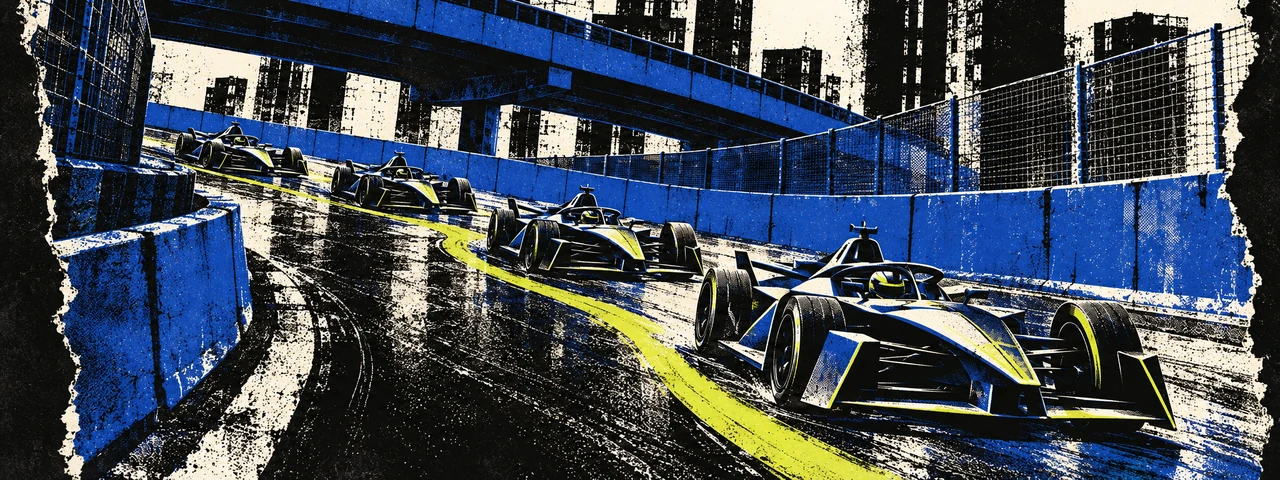
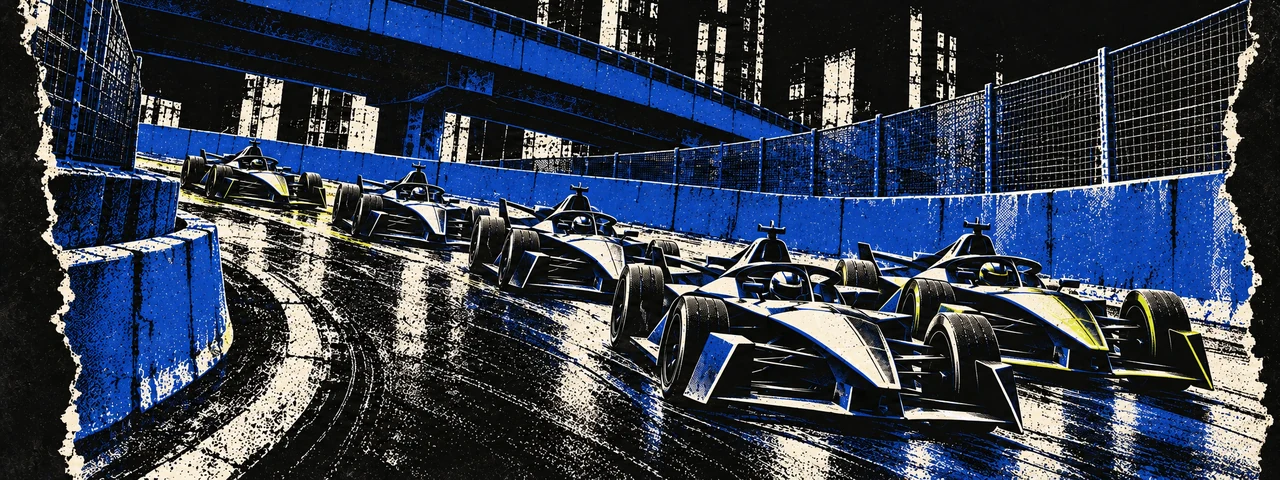
The E-Prix is 45 minutes, low downforce, with a mandatory Pit Boost stop and an 8-minute Attack Mode, and energy management decides it. The E-Prix Unleashed runs only at double-headers: 30 minutes, high downforce, no Pit Boost, a 6-minute Attack Mode, built for raw speed. Officially both pay full points.
In Full Charge
We score them differently. An E-Prix win is worth 25 and an Unleashed win 15, with both tables paying down to tenth place. Places gained (the Charger, below) are capped at 8 in an E-Prix and 3 in an Unleashed.
The E-Prix is a pack race. Nobody wants to lead early, because the leader burns the most energy, and ten-place swings in the closing laps are normal. The sprint mostly converts the grid. So places gained are worth a lot in one race and a little in the other, and your squad wants a sprinter and a saver.
Attack Mode
On track
Drivers arm Attack Mode by driving through an activation zone off the racing line. They get extra power for a fixed total time (8 minutes in an E-Prix, 6 in an Unleashed) across a set number of activations, and they choose when.
In Full Charge
Your Attack Mode driver scores ×2 for the weekend, negative points included. On a double-header you get two activations: put both on one driver, or name a sprint driver for the Unleashed and an energy driver for the E-Prix. The nomination carries over until you change it, and changing it is free.
On track the question is when to deploy. In the game it’s on whom. A retirement doubles too, which is what makes it a decision rather than a formality.
Pit Boost
On track
Every E-Prix has a mandatory Pit Boost: a stop of about half a minute that adds energy at very high power and shuffles the order around the stops. The Unleashed has none.
In Full Charge
Two chips, one of each per season. Full Recharge gives you one transfer window of unlimited swaps. Overdrive makes your Attack Mode drivers score ×3 instead of ×2 for one weekend.
The chips are named for the stop: one shot of energy that changes your race. Overdrive upgrades every activation that weekend, split or not, and if the weekend is cancelled you get it back.
Energy management
On track
Cars start with less energy than a flat-out race needs. Drivers lift and coast before corners and recover energy under braking, and the winner is often whoever saved the most for the last laps.
In Full Charge
The Charger pays +1 for every place a driver gains from the official starting grid to the flag, up to +8 in an E-Prix and +3 in an Unleashed. Places lost cost nothing.
This is why a cheap driver who starts at the back is a real pick: P24 to P16 in an E-Prix collects the full 8. We don’t score energy or efficiency directly. Neither is in the official classification, and we score only official documents.
Retirements and penalties
On track
Energy overuse, tyre rules and contact all bring penalties, and some land after the race, occasionally days later.
In Full Charge
A retirement or an unclassified finish scores -3, a disqualification -5, and a driver who doesn’t start scores 0. A disqualified driver keeps their qualifying points. When a result is corrected, everyone’s score is recomputed.
Your points can move after the weekend; your squad can’t. A late penalty never reopens a window you’ve already used.
Teams and powertrains
On track
Twelve teams, 24 cars. A handful of manufacturers build powertrains and supply customer teams, so one powertrain can run four to six cars. GEN4 is a clean sheet, the first all-new car since 2022/23, and nobody knows the pecking order yet.
In Full Charge
Your team picks each score both their cars’ finish and Duel points in every race, whoever is driving. They earn no Charger and take no penalties. The squad builder also shows your powertrain exposure: how many of your six picks run on one powertrain, turning amber at four.
Team picks are the hedge in a reset year. When the pecking order shows, it shows for whole powertrains at once, which is what the exposure strip is for. There’s no cap: five cars on one powertrain is your call.
The powertrain map: grid forming. It fills in when the price book is published.
The season
On track
Thirteen weekends and 21 races, from Mexico City on 16 Jan to Tokyo on 25 Jul: five single-headers and eight double-headers. The Asian rounds run overnight in the Americas.
In Full Charge
Between weekends a transfer window opens with two swaps. Prices move every window on value for money, the points per credit each competitor scored over their last three weekends, by a formula that is public and frozen once registration opens.
If a result is slow to arrive, the next window opens anyway 36 hours after the last race, so a slow result never costs you a window.
Championships
On track
The drivers’ and teams’ titles are decided at the finale in Tokyo.
In Full Charge
Before round 1 locks you make five season picks: the top rookie (10), the best powertrain (15), the teams’ champion (20), the drivers’ champion (30) and how many different drivers win a race (10). They score once, at Tokyo, worth up to 85 points.
They lock with round 1, so you call them before anyone has seen a GEN4 car race. Join after that and you play without them.
A worked weekend
One double-header for a made-up squad: four lettered drivers and two teams. Attack Mode is split, with Driver B on the E-Prix and Driver A on the Unleashed. The breakdown is laid out the way yours will be after every real weekend.
- Driver A (The qualifier): E-Prix (P3 from P2): finish 15, Duels 3 = 18; Unleashed (P1 from P1): finish 15, Duels 5, ×2 = 40. Weekend: 58.
- Driver B (The saver): E-Prix (P4 from P19): finish 12, Duels 0, Charger 8, ×2 = 40; Unleashed (P9 from P12): finish 2, Duels 0, Charger 3 = 5. Weekend: 45.
- Driver D (The bad luck): E-Prix (DNF from P10): finish 0, Duels 0, DNF -3 = -3; Unleashed (P7 from P9): finish 4, Duels 0, Charger 2 = 6. Weekend: 3.
- Driver E (The penalty): E-Prix (P10 from P7): finish 1, Duels 1 = 2; Unleashed (DSQ from P6): finish 0, Duels 1, DSQ -5 = -4. Weekend: -2.
- Team Alpha (Driver A’s team): E-Prix: finish 19, Duels 4 = 23; Unleashed: finish 22, Duels 7 = 29. Weekend: 52.
- Team Delta (Driver D’s team: both cars count, the DNF costs nothing): E-Prix: finish 2, Duels 0 = 2; Unleashed: finish 5, Duels 0 = 5. Weekend: 7.
Weekend total: 163. Both activations on Driver A would have scored 161. The split was worth 2.
What we don’t score
- Fastest lap: It no longer pays championship points, so it doesn’t pay here.
- Energy and efficiency: Not in the official classification, and we score only official documents.
- Fanboost: The championship dropped it.
- Practice times: Practice is practice.
Glossary
- Attack Mode: On track, extra power armed through an off-line activation zone. In the game, the driver whose points are multiplied for the weekend.
- Pit Boost: The mandatory high-power charging stop in every E-Prix.
- Duels: Head-to-head one-lap qualifying knockouts for the fastest eight.
- E-Prix: The 45-minute energy-managed race. Every weekend has one.
- E-Prix Unleashed: The 30-minute flat-out sprint, run only at double-headers.
- GEN4: The new car for 2026/27, the first all-new design since 2022/23.
- Powertrain: Motor, inverter and gearbox: the part manufacturers build and teams race.
- Customer team: A team racing a powertrain built by another manufacturer.
- Regen: Energy recovered under braking.
- Lift-and-coast: Lifting off early before a corner to save energy.
- Charger (Full Charge term): Points for places gained from the grid, capped per format.
- Full Recharge (Full Charge term): A chip: one window of unlimited swaps.
- Overdrive (Full Charge term): A chip: Attack Mode scores ×3 for one weekend.
- Window (Full Charge term): The time between weekends when you can make transfers.
- Lock (Full Charge term): The moment a weekend’s choices freeze: the start of its first qualifying.
- Bank (Full Charge term): Credits you hold but haven’t spent.
- Team value (Full Charge term): What your squad is worth at today’s prices. Buy risers and it grows.
The rules in full
Your squad
Pick four drivers and two teams for no more than 100.0 credits before the season opener. Your squad carries over from weekend to weekend: forget about it for a month and it keeps scoring. Squads can overlap across league-mates. Join late and you build from the current prices with a fresh budget, scoring from the next weekend.
Two kinds of race
Every weekend is one round. A double-header holds an E-Prix and a shorter E-Prix Unleashed, and each race scores by its format, never by its order in the weekend. Classified finishers in an E-Prix score 25 / 18 / 15 / 12 / 10 / 8 / 6 / 4 / 2 / 1 for places 1–10; in an Unleashed, 15 / 11 / 9 / 7 / 6 / 5 / 4 / 3 / 2 / 1. If the FIA awards reduced points for a shortened race, finish points scale the same way.
Qualifying Duels
Each race has its own qualifying. Losing a quarter-final scores 1, a semi-final 2, the final 3, and pole 5. If the Duels are cancelled after the groups, the eight who would have gone through score 1 each; if only the groups ran, or qualifying didn't happen, nobody scores.
Charger
+1 for every place a classified driver gains from the official starting grid to the flag, capped at +8 in an E-Prix and +3 in an Unleashed. The E-Prix is the energy race, where big late swings are normal; the sprint mostly converts the grid. A pit-lane start counts as the last grid slot. Places lost cost nothing.
Retirements
A DNF or an unclassified finish scores -3. A disqualification scores -5 and forfeits finish and Charger points, but qualifying points stand. A driver who doesn't start scores 0.
The team picks
Each of your teams scores both of its cars’ finish and qualifying points in every race, whoever is driving, including a stand-in. Teams earn no Charger points and take no retirement penalties: they are the steady hedge.
Attack Mode
Each weekend one of your drivers is your Attack Mode driver and scores ×2 for the weekend, negative points included. On a double-header you get two activations: put both on one driver, or name a sprint driver for the Unleashed and an energy driver for the E-Prix. The nomination carries over until you change it, and changing it is free.
Pit Boost chips
You get one of each per season. Full Recharge gives one transfer window of unlimited swaps; your bank still has to cover them. Overdrive makes your Attack Mode drivers score ×3 for one weekend. If that weekend is cancelled or every race is voided, Overdrive comes back to you.
Transfer windows and the market
Between weekends a window opens with two swaps, use them or lose them: one driver for another, or one team for another. Prices move every window on value for money, the points each competitor scores per credit averaged over their last 3 weekends, and cheaper competitors move faster than expensive ones. Prices never change while a window is open, and the pricing formula is frozen for the season once registration opens. Sell a riser and your bank grows; a price drop never makes a squad illegal.
One lock a weekend
Squads, Attack Mode and chips lock at the start of the weekend’s first qualifying session, and that one lock covers both races of a double-header, so nothing is decided after a race you might have missed. Locks show in UK and US Eastern time and are the same instant for everyone. League-mates see your squad only once it locks.
Season picks
Before round 1 locks, call the top rookie (10), the best powertrain (15), the teams’ champion (20), the drivers’ champion (30), how many different drivers win a race (10); being within 1 on the winners count scores 5. Picks lock with round 1 and score once, at the finale, worth up to 85 points. Join after round 1 and you play without them.